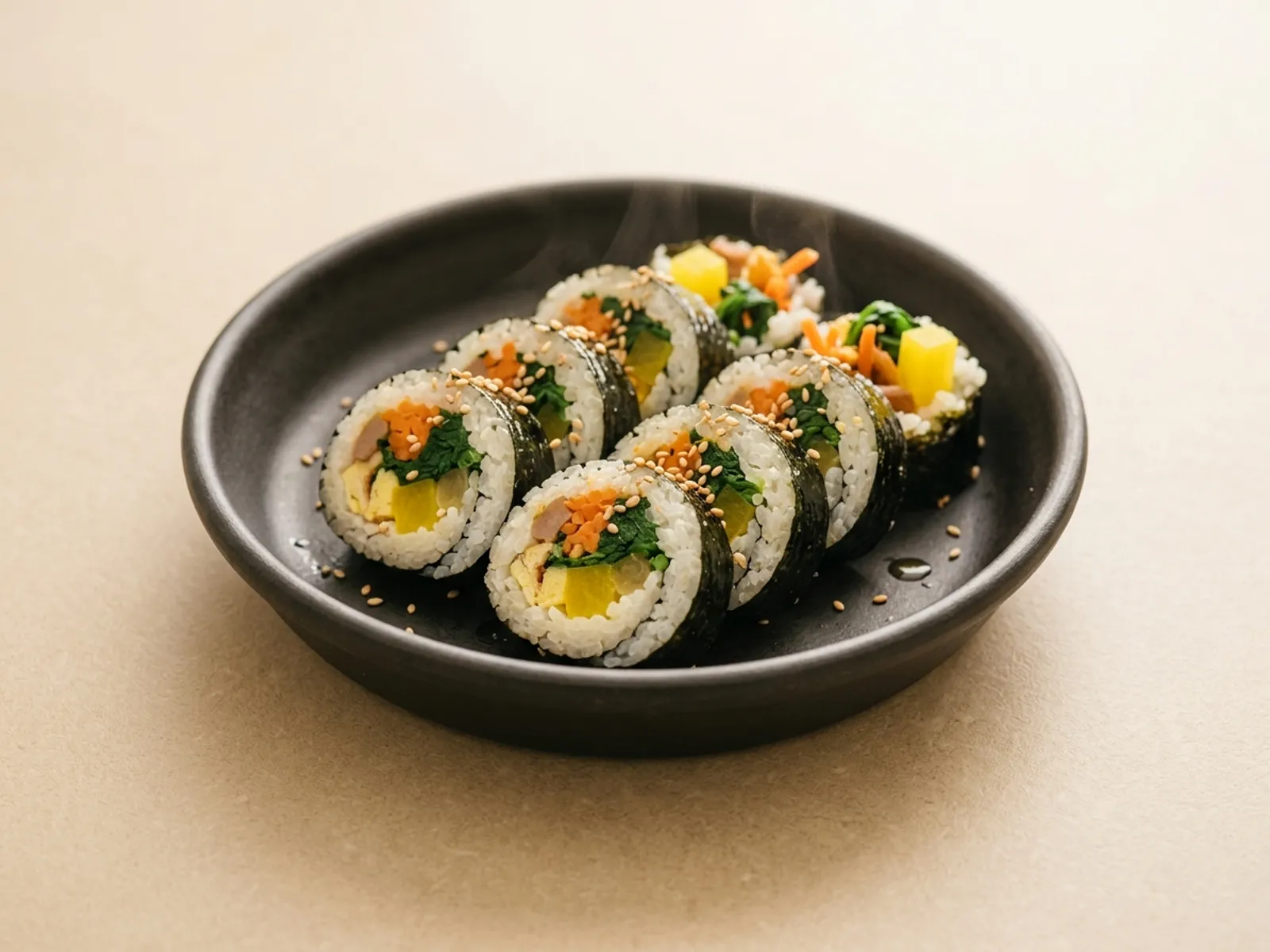
lunchbox · kid favorite
Gimbap
Ingredients
Sauce
Steps
Beat the eggs, cook into a thin omelet, and slice into long strips about 1cm (1/2 inch) wide.
~7 min
Julienne the carrot and saute briefly with a pinch of salt; seed the cucumber and cut into long strips.
~7 min
Season the warm rice with the sesame oil, salt, and sesame seeds, folding with a cutting motion, then let it cool slightly.
~4 min
Why: Season the rice while it's warm so it absorbs evenly; letting it cool a bit keeps the seaweed from getting soggy.
Lay the seaweed rough side up and spread a thin layer of rice, leaving the top third bare.
~4 min
Watch out: A thick layer of rice guarantees a blowout — spread it so thin the seaweed almost shows through.
Line up the fillings in a single row across the lower third of the rice.
~2 min
Using a bamboo mat (or parchment paper), roll once firmly over the fillings to form a tight core, then keep rolling, pressing after each turn.
~4 min
Why: Once that first firm turn sets the core, the rest practically rolls itself — that's the whole technique.
Watch out: Roll it loosely and it falls apart when you slice — don't baby it for fear of breaking it.
Seal the edge with a few grains of rice and brush the outside lightly with sesame oil.
~2 min
Wet the knife with water or sesame oil before slicing, and wipe the blade every cut or two.
~4 min
Tips
- —
Tuck in leftover bulgogi and you've got bulgogi gimbap.
- —
Squeeze the pickled radish and cucumber dry with paper towels or the rolls get soggy.
- —
Not eating right away? Leave the rolls whole — sliced gimbap dries out and goes soggy.
- —
No bamboo mat? Parchment paper works just fine.
Storage
Refrigerating hardens the rice, so same-day is best — dip leftovers in beaten egg and pan-fry them.